
The pandemic years transformed gaming into one of the world’s largest entertainment industries almost overnight. Lockdowns, remote work, and home-based lifestyles pushed millions of people toward gaming across PCs, consoles, and mobile devices. But as the world normalized, a new question emerged: which gaming ecosystem is actually best positioned for the future? At first glance, consoles still appear dominant. PlayStation continues to rely on blockbuster exclusives and premium experiences, Nintendo remains highly successful with its hybrid Switch ecosystem, and Xbox has evolved into a subscription and cloud-focused platform. Yet beneath the surface, PC gaming has quietly become one of the strongest long-term growth sectors in the industry.
Recent market intelligence from Newzoo shows that global PC and console gaming revenues have both expanded significantly since 2015, but the long-term trajectories are beginning to diverge. During the pandemic boom between 2020 and 2021, console gaming experienced explosive growth driven by hardware demand, blockbuster releases, and stay-at-home entertainment spending. However, forecasts now suggest that PC gaming is entering a steadier and more structurally supported growth phase, with PC revenues projected to surpass console gaming revenues by 2028. The chart below highlights this changing balance. While console gaming benefited heavily from cyclical surges during the pandemic years, PC gaming has continued building momentum through broader ecosystem expansion, rising global player numbers, Steam-led distribution growth, and increasing overlap with AI and creator technologies.
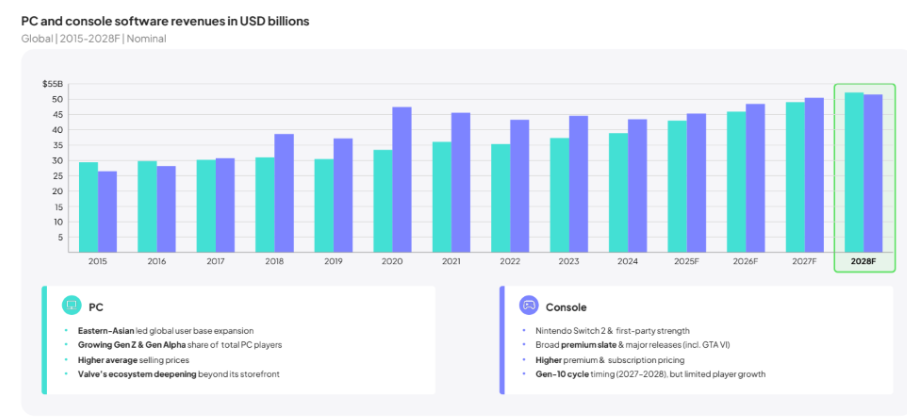
One of the biggest reasons behind this shift is flexibility. Modern gaming PCs are no longer just gaming devices. They have evolved into multifunction ecosystems that combine gaming, streaming, AI experimentation, content creation, productivity, and social interaction within a single platform. Unlike consoles, which are designed primarily for entertainment, PCs continue to benefit from rapid advances in computing, graphics processing, and artificial intelligence. This matters because the future of gaming is becoming increasingly tied to AI-driven technologies. AI-enhanced graphics, adaptive gameplay systems, procedural world generation, AI-powered NPCs, and creator tools all require significant computing power and open software environments. PCs are naturally positioned for this transition because they allow users to upgrade hardware, experiment with software, and access wider development ecosystems more freely than consoles or mobile devices.
The rise of AI has also strengthened the broader PC ecosystem itself. Gaming hardware such as GPUs and high-performance processors are now valuable not only for gaming, but also for AI workloads, local AI models, streaming, editing, and creative applications. In many ways, gaming PCs have evolved into next-generation compute hubs rather than simple entertainment machines. At the same time, platforms such as Steam have fundamentally reshaped how PC gaming operates. Open ecosystems, modding communities, indie publishing, and long-tail game discovery continue to expand rapidly. Newzoo’s data shows that titles outside the traditional Top 20 games are capturing a growing share of PC playtime, reflecting a wider and more diverse gaming ecosystem. Gaming behaviour itself is also changing rapidly.
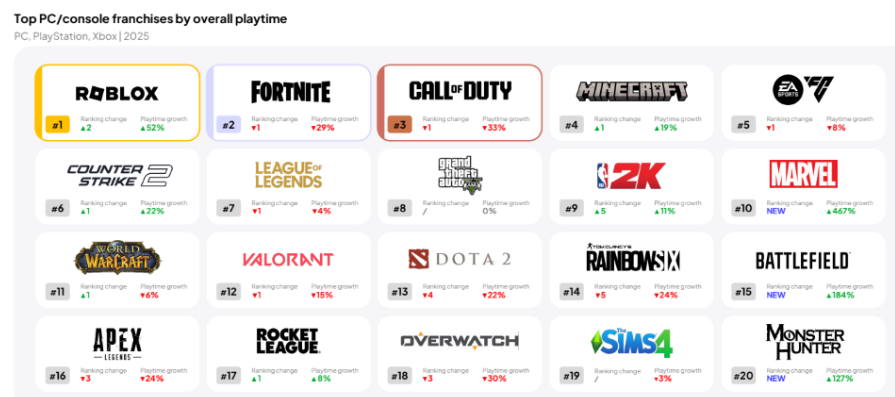
The most-played franchises of 2025 reveal a major shift in gaming behaviour. While traditional AAA titles still dominate headlines, platforms like Roblox and Minecraft are increasingly leading overall player engagement, highlighting the growing influence of creator-driven, social, and persistent gaming ecosystems over conventional one-off releases. This trend also reflects broader changes in what players now value. Sandbox and creator-driven experiences continue gaining momentum, while traditional Battle Royale and shooter categories are showing signs of structural slowdown. Roblox alone became the most-played gaming franchise across PC and console ecosystems in 2025, overtaking long-standing giants like Fortnite and Call of Duty.
This does not mean consoles are disappearing. Consoles still dominate the living-room gaming experience and remain highly attractive for players seeking simplicity, exclusives, and plug-and-play convenience. Nintendo, in particular, continues to benefit from strong hybrid positioning and broad demographic appeal. However, the post-pandemic gaming landscape increasingly favours adaptable ecosystems rather than fixed hardware models alone. As AI, creator economies, streaming, and cross-platform experiences continue reshaping the industry, PC gaming appears uniquely positioned to benefit from nearly every major trend simultaneously.
The future of gaming may no longer belong to a single device. But if one platform currently sits closest to the centre of gaming, computing, AI, and digital creation combined, it is increasingly the PC.